
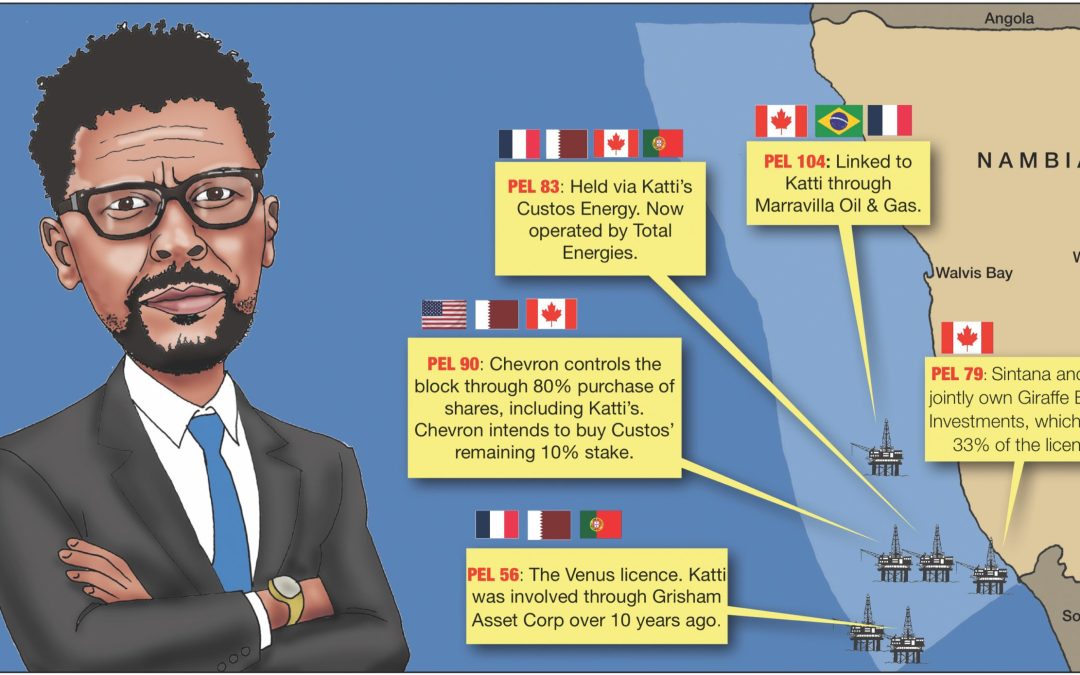

Katti and the seven countries hunting for Namibian oil
By Nishi Felton, Timo Shihepo and Shinovene Immanuel | 13 November 2026
BRITISH geoscientist Phil Birch knew he was losing the pitch to convince TotalEnergies to invest in an oil exploration project in Gabon.
Birch was in his London office in 2016, making the case for the coast of central Africa. However, the French oil giant was not interested.
“It was really embarrassing,” he tells The Namibian.
Within 30 minutes, TotalEnergies had decided to walk away.
Before the TotalEnergies team left, they asked Birch what else his company – Impact Oil and Gas – had on its books.
“Well, we’ve got Namibia but most of the international oil companies haven’t been interested,” he recalls telling them.

Birch then started talking about the Orange Basin, off Namibia’s southern coast. His presentations suggested the Namibian acreage could hold over a billion barrels of oil.
“They liked the work that we’d been doing,” Birch says.
In 2017, TotalEnergies joined the exploration project. Five years later, it announced it had found light oil at a prospect named Venus.
Birch’s afterthought is now the most advanced oil project in Namibia.
The licence behind it traces back to Namibian businessman Knowledge Katti, who has been called a pioneer of Namibia’s oil journey by his supporters.
Katti, now worth over N$1 billion according to Billionaires. Africa, has a reputation as a wheeler-dealer who drew ministers and senior officials into his business dealings. He was a friend of former president Hage Geingob.
His name appears in almost every major oil block discovery, and the National Petroleum Corporation of Namibia (Namcor) and energy ministry documents link his licences to the arrival of the international oil companies
Katti has declined to comment on this article.

LEAGUE OF NATIONS
Seven countries have companies in the oil hunt off Namibia’s coast: France (TotalEnergies), the United States (Chevron), Britain (Shell and BP), Australia (Pancontinental), Canada (Sintana, Stamper and Oregen), Portugal (Galp) and Qatar (QatarEnergy).
Brazil’s Petrobras would make eight if the government approves the purchase of petroleum exploration licence (PEL) 104 announced in February.
Venus is the most advanced project, with TotalEnergies putting its resources at about 750 million barrels. Mopane is larger but less proven, at 800 million to 1.1 billion barrels.
Katti is a partner in at least five of the 11 active exploration licences in the Orange Basin near the discoveries. In some, his company’s stake is larger than that of Namcor.
In March 2022, a month after the Venus discovery, Canadian Sintana Energy announced that it had paid N$65 million for a 49% stake in Katti’s Inter Oil, which owns Trago and Custos.
Katti became a shareholder and non-executive director at Sintana, which has since continued to expand its Namibian footprint.

CONCERNS
Using Namcor licence maps, business registry records and company filings, The Namibian traced who holds the blocks around the Venus and Mopane discoveries, how they got them and what they paid.
This article examines opaque licensing and concerns that local ownership is concentrated among a few people.
Independent Patriots for Change leader in parliament Imms Nashinge this week told The Namibian that concentrated ownership of oil blocks is a problem.
“If one person is allowed to be all over [the oil blocks], it creates an unfair competitive advantage. There must be a limit,” Nashinge said.
He said laws should regulate competition over Namibian resources and ensure the benefits of oil are distributed fairly.
“Namcor, as a government entity, is a bit different. But for individuals it sets a very dangerous precedent,” he said.
He said concentration also raises questions about how licences were obtained and whether political connections favoured certain applicants.
“There is a possibility that you apply and because of outside power and control, you can easily be blocked in the process,” Nashinge said.
“According to information I have received, ministry officials are sharing [ministry] decisions to third parties. [After individuals have been granted licences], they have received calls from outside individuals asking them to give up a piece of the licence,” he said.
Former Namcor chief executive Maureen Hinda says ownership is skewed.
“I know a few people that have been pushed out from ownership and unfairly treated.”
MEETING IN LAGOS
During a visit to Walvis Bay last week by Africa’s richest businessman, Aliko Dangote, Katti recalled when the two first met.
“I met Mr Dangote nine years ago in Lagos. We had lunch together, with friends. At that time, I did not yet close my deals to bring one of the biggest investors in the oil and gas, which is today Chevron and TotalEnergies. They were not yet in Namibia.
“But I was inspired by that lunch (with Mr Dangote). My investor was Tunde Folawiyo. I was the young guy that was actually talking about the previous president [Geingob]. So I just wanted to say thank you so much,” he said.
Folawiyo is a Nigerian businessman who runs the Yinka Folawiyo Group. Forbes Magazine reported that his other assets include a minority stake in Nigeria’s Access Bank, which received approval last month to operate in Namibia.
The Namibian could not reach Folawiyo for comment.

‘ECONOMIC EMANCIPATION’
Apartheid-era sanctions stopped exploration from the 1970s until 1990, when licensing rounds reopened Namibia to companies funding their own exploration.
Leake Hangala, the energy ministry’s first permanent secretary in 1990, says Namibia’s ambition for the oil industry has remained constant since independence.
“We wanted to draw a win-win situation between the investors, the government and people of Namibia,” he says.
Hangala says Namibians are not prevented from applying for oil licences.
At the turn of the century, Namibia introduced an open licensing system, allowing locals to apply for individual licences and then seek international investors.
That was when Katti, an accountant who worked at Barden International – the same company that brought Chevrolet vehicles and Michael Jackson to Namibia in the 90s – saw an opportunity.

In 2012, while the world watched oil drilling off Walvis Bay, a quieter deal was taking shape further south over PEL 56, which covers block 2913B in the Orange Basin.
Documents show that Southern Oil and Gas Explorers, the consortium initially awarded the licence, was assembled by former mines ministry consultant Charles Shanyengana, son of former president Hifikepunye Pohamba’s media adviser, Mukwaita Shanyengana.
Its beneficial owners included Shanyengana, the Science and Development Group of companies, the National Fund for Economic Emancipation, and Frans Mushimba, son of the late businessman Aaron Mushimba, former president Sam Nujoma’s son-in-law.
Shanyengana said he started the consortium in the mid-2000s to research Namibia’s petroleum space and ended up applying for block 2913B, now PEL 56, and block 2813A.
This is where TotalEnergies struck oil years later.
“No political connections played any role in the research, identification nor application for my former oil blocks,” he said.
He said the blocks were considered risky and not commercially viable investments at the time.
Shanyengana said he approached Aaron Mushimba after the licences were granted, for his international networks and help raising capital, having failed to raise funding at oil conferences.
Shanyengana said Mushimba’s son, Frans Mushimba, said the shares intended for his father could be given to him instead.
“Frans Mushimba simply instructed me that his father indicated that he is already over-committed to too many projects; and can only aid by affording me an opportunity to present my oil business-case to their American investors; and requested I transfer the promised shares to him – being Frans Mushimba,” he said.
Frans told The Namibian that he exited the venture in the early stages.
“The person who was in charge was Shanyengana,” he said.

THE CONNECTION
Shanyengana’s Southern Oil and Gas Explorers later teamed up with Grisham Asset Corp, a Canadian outfit owned by Katti, and secured licence 56 from the mines ministry in April 2012. The consortium’s shares were then sold to Katti.
Birch’s small oil exploration company, then called Black Star Petroleum, suspected that the Orange Basin might contain oil based on two data points – the Kudu gas field and drilling results from South Africa.
“That hunch turned out to be right, but… it was a real guess,” he tells The Namibian.
Birch contacted Imms Mulunga, then petroleum commissioner, and his assistant Maggy Shino.
“They recommended that I speak to Knowledge Katti, who held the licence,” he says.
Katti agreed to sell 80% of the licence to Black Star.
Impact Oil and Gas bought Black Star in 2014, took over as operator, and in 2017, won over TotalEnergies, which acquired 70% of the project.
After the Venus discovery, Impact sold 10.5% of its interest to TotalEnergies for US$99 million (about N$1.8 billion). QatarEnergy entered in 2019 and now owns 35.25% of Venus
.
South African trade-unionist-turned-businessman Johnny Copelyn, whose company is a major shareholder in Impact Oil and Gas, was one of the biggest winners, with the value of his stake estimated at N$1.4 billion in 2023.
Mulunga, who was accused of accepting a car bought by Katti, told The Namibian on Wednesday that few believed there was oil in Namibia in the early days and that, apart from the Kudu gas discovery, the Orange Basin’s potential was unknown.

“Phil Birch being an excellent geologist, Knowledge Katti a dreamer, and Imms Mulunga, with the assistance of Maggy Shino, being a fearless and visionary industry leader, created the perfect mix of factors,” Mulunga said.
“We aggressively marketed and licensed the country and created a perfect exploration ecosystem of major oil companies who picked up various licences from smaller companies,” he said. Mulunga said he hopes the current leaders will continue with “the same strategic leadership”.
THE BIGGER PRIZE
In early 2024, Galp Energia announced it had found light oil about 250 kilometres off the coast of Lüderitz, in block 2813A, northeast of Venus.
Explorations in following years confirmed that the Mopane complex could hold 10 billion barrels of oil.
Galp has been active in the area since 2012, when it bought 14% of PEL 83 (then PEL 28), the licence covering the block. Its Namibian partner in 2016 was Katti’s Custos Investments, renamed Custos Energy in 2017. Custos currently holds 10%.
In 2024, Galp said it would sell half of its 80% stake in the block. TotalEnergies won, striking a deal in December 2025.
The deal closed on 3 September. TotalEnergies now owns 40% of PEL 83, making it the operator for both Venus and Mopane, and is targeting an investment decision on Mopane in 2028.
The post Namibia’s oil power circle appeared first on Investigation Unit.