
By Zwelethu Dlamini
Nearly five years after the June–July 2021 unrest, many people who were shot, injured or lost relatives during the violence say they are still waiting for criminal investigations and civil claims to be resolved. Interviews conducted by Inhlase with survivors, bereaved families, lawyers and victims’ organization indicate that while numerous cases remain before the courts, questions about accountability and compensation also remain unresolved.
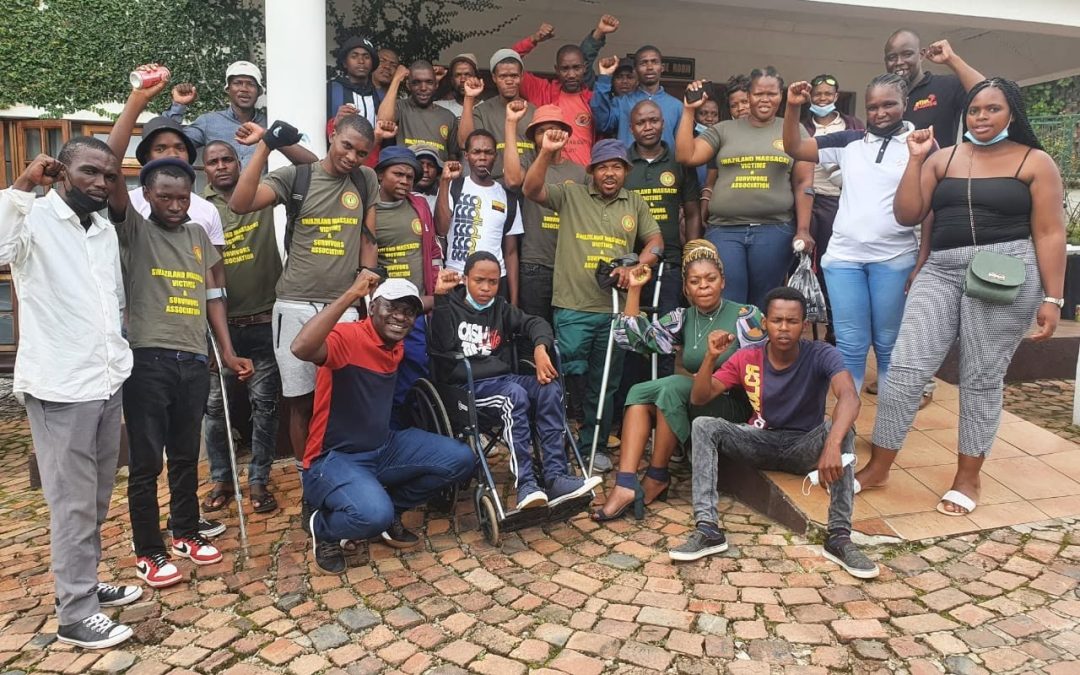
For many victims, these delays extend beyond the courtroom. Several people interviewed by Inhlase said they continue to live with permanent injuries, financial hardship and uncertainty about whether anyone will be held accountable for the deaths and shootings documented during the unrest. Others say they have received little information about the progress of investigations or compensation claims nearly five years after the violence.Behind those legal processes are survivors living with permanent injuries and families mourning relatives who were killed, many of whom continue to wait for answers, accountability and compensation nearly five years after the unrest.
According to Eswatini Litigation Centre spokesperson lawyer Mzwandile Masuku The unresolved legal processes broadly fall into three areas.
“There are different classes of cases of the unrest: People who were charged, arrested, detained and then released on bail but trials it seems will never take off with government keeping that money,” he said.
Masuku clarified that the above include women, a majority working in the industrial sites, and children below 18 at the time.
Then there are persons who were injured or who lost family members, those are civil matters and they are also pending in Court.
“Then you have persons charged under the Suppression of Terrorism Act (STA), primarily the so-called Solidarity Forces, those cases are also pending in Court but in majority of these were never granted bail.
The other issue concerns the lack of implementation of recommendations made by the Commission on Human Rights and Public Administration (CHRPA) following its investigation into the unrest.
In its preliminary report released on 29 October 2021, CHRPA documented 46 deaths, 245 gunshot injuries—including 22 people who sustained multiple gunshot wounds—and 337 arrests and detentions. It recommended that government conducts prompt, independent and impartial investigations into deaths involving members of the security forces, accountability where wrongdoing is established, reparations for victims and their families, and institutional reforms aimed at preventing similar violations.

The Commission recommended that the government of Eswatini government conducts a full, transparent and independent investigation into the root causes of the unrest and the human rights violations committed during the protests, including the alleged excessive use of force by law enforcement officers. It also called for security forces and law enforcement personnel to be held accountable for the use of lethal and indiscriminate force against both protesters and civilians who were not participating in the demonstrations.
In addition, the Commission urged the government to protect the constitutional rights to peaceful assembly, freedom of association and freedom of expression, and to establish a long-term national dialogue to address the underlying socio-economic and political grievances that gave rise to the protests.
Nearly five years later, lawyers and victims’ organization say many of those recommendations remain outstanding.
Against that background, lawyer Sibusiso Nhlabatsi, who represents eight victims and several accused persons in cases arising from the unrest, believes the period immediately after the violence presented an opportunity for national reconciliation that was never pursued.
“After the unrest, government declared victory instead of creating a platform for national reflection.”
According to Nhlabatsi, there was no structured national process to examine the causes of the unrest, hear from affected communities or consider reforms that could reduce the likelihood of similar events in future.
Instead, he said, the justice process became intertwined with politics.
Nhlabatsi said the legal experiences of the various groups affected by the unrest have differed significantly.
He said many accused under the terrorism legislation remained in custody for lengthy periods, were frequently denied bail and were detained at Matsapha Maximum Correctional Centre under harsh conditions.
He also questioned the level of security deployed whenever some accused persons appear in court.
“These cases are politicised.”
According to Nhlabatsi, heavily armed escorts and extensive security deployments have become routine even when young, accused persons are brought before court, creating the perception that the prosecutions are being treated differently from ordinary criminal matters.


Different standards of accountability
Nhlabatsi said one of the issues raised repeatedly by victims is the apparent difference between how civilians and members of the security forces have been treated by the criminal justice system.
Several victims interviewed by Inhlase said they have received little information about investigations into officers allegedly responsible for shootings during the June–July 2021 unrest.
Nhlabatsi said this reflects what he considers to be a broader imbalance in the criminal justice process. According to him, civilians continue to face prosecution while investigations involving members of the security forces have not progressed at the same pace
“The law appears to be applied differently depending on who the accused is.”
As an example, Nhlabatsi referred to the shooting of two civilians in Lomahasha.
He alleged that the police officer implicated was initially placed on precautionary suspension before later returning to duty rather than facing criminal prosecution.
Government had not responded to questions regarding specific investigations into police shootings by the time of publication.
When Inhlase sought comment from the Royal Eswatini Police Service, Acting Deputy Chief Police Information and Communications Officer Inspector Mazwi Ndzimandze said:
“This is a national issue any and all enquires are obtainable at the PM’s office.”
Questions were subsequently referred to the Prime Minister’s Office. But the government acting spokesperson Thabile Mdluli declined to comment.
Why many civil claims have taken years
While victims often describe the pace of litigation as frustrating, Nhlabatsi said the delays have several legal causes.
He pointed to the Limitation of Legal Proceedings Against Government Act of 1972, which sets strict procedural requirements and time limits for instituting claims against government.
According to him, many victims were still recovering from gunshot injuries or trauma when those deadlines expired.
Some successfully applied to court for permission to institute claims outside the prescribed period, while others did not.
He added that litigation against government generally involves lengthy exchanges of pleadings and documents before matters are enrolled for hearing.
Although victims understandably experience the delays as excessive, he said many of the cases are progressing within the normal pace of civil litigation before the High Court.

Building the cases
Mzwandile Masuku, spokesperson for the Eswatini Litigation Centre (ELC), said the litigation process began after concerns that the official picture of the June–July 2021 unrest was incomplete.
He said the Eswatini Litigation Centre, working with a consortium of civil society organisations, launched an evidence-gathering exercise after the Commission on Human Rights and Public Administration noted in its preliminary report that the number of people killed and injured was likely higher than the figures it had documented.
Rather than waiting for victims to come forward, members of the consortium travelled to communities across the country to document alleged violations and gather supporting evidence from survivors, families of those killed and other affected individuals.
Masuku said the exercise documented approximately 300 respondents.
Lawyers then assessed each file to determine whether there was sufficient information and supporting documentation to institute legal proceedings.
According to Masuku, 93 civil claims met that threshold and were prepared for litigation. Other files could not proceed immediately because they lacked essential information or supporting documents.
To pursue the litigation, the Eswatini Litigation Centre coordinated a network of lawyers.
Masuku said about 16 lawyers were part of the litigation centre, with the number later increasing to 23. However, only seven lawyers ultimately continued litigating the cases.
He attributed the reduction to several factors, including the financial costs associated with prolonged litigation and what he described as a difficult operating environment for lawyers involved in unrest-related matters.
Masuku said lawyers representing victims faced financial pressures and operated in what he described as a hostile environment. He said organisations involved in accountability work struggled to secure funding, while some lawyers were accused of being “terrorist sympathizers” because they represented victims of the unrest.
“One of the accusations made against me personally was that I was a terrorist sympathizer or supporter,” he said
The 93 civil claims were eventually distributed among the seven lawyers who remained.
Masuku said the Eswatini Litigation Centre plans to convene a meeting for those lawyers before the end of the year to review the status of every allocated file and determine the next steps in the litigation.
Concerns reflected internationally
The concerns raised by Masuku are reflected in findings published by the International Commission of Jurists (ICJ). In its 2026 submission to the United Nations Human Rights Council’s Universal Periodic Review of Eswatini, the ICJ stated that lawyers representing clients associated with the June 2021 unrest have faced intimidation, harassment, economic retaliation and pressure because of the clients they represent.
“Lawyers indicate that numerous cases under these same laws have also been brought in connection with the civil unrest of June 2021, showing that the heavy-handed application of these overly broad laws remains a common State response to dissent. This has increased since the civil unrest of June 2021, which involved pro-democracy protests deemed in their entirety by the Eswatini State to constitute terrorist activity. Since then, it has been observed that “any political act” is now viewed as a “sequel to that civil unrest and hence people are charged as terrorists”. Simply put, the Terrorism Act “allows the state to reclassify any perceived threat, no matter how small or non-violent, as an act of terrorism”, which the State now routinely does.
The submission states that lawyers interviewed by the ICJ reported operating in an environment that inhibits their ability to act independently, particularly in cases linked to the unrest.
The ICJ further states that the killing of human rights lawyer Thulani Maseko and the broader reduction of civic space have intensified these challenges.
The submission also notes that lawyers have reported surveillance, threats and pressure connected to their professional work and recommends measures to strengthen the independence and protection of the legal profession.
Human Rights Commission recommendations remain outstanding
Nhlabatsi said government also missed an opportunity to use the findings of the Eswatini Commission on Human Rights & Public Administration as the basis for reconciliation.
“Government should have acted on the Eswatini Commission on Human Rights & Public Administration report.”
He said the Commission’s recommendations could have provided the foundation for reparations, institutional reform and national dialogue.
“It should have reached out to all victims and promoted reconciliation and nation building.”
The CHRPA preliminary report recommended independent investigations into deaths involving security forces, accountability where wrongdoing is established, reparations for victims and broader institutional reforms.
The International Commission of Jurists observed in its 2026 submission that, despite Eswatini accepting similar recommendations during previous United Nations human rights reviews, there had been “little, if any, progress” in implementing those commitments.
Victims’ organisations face their own challenges
Nhlabatsi also expressed concern about some organisations formed to represent victims.
He said internal leadership disputes have, in some instances, diverted attention away from legal claims and advocacy for compensation.
According to him, organisations representing victims should remain focused on securing justice, accountability and reparations for those affected.
Legal options remain
Despite the passage of five years, Nhlabatsi believes legal avenues remain available.
He said victims can continue pursuing civil claims against government.
He also believes court proceedings could be brought requiring government to implement recommendations made by the Commission on Human Rights and Public Administration following its investigation into the unrest.
According to him, because the Commission is a constitutional institution, its findings provide an important legal basis for future accountability measures.
While lawyers continue to pursue court proceedings, many victims interviewed by Inhlase say their immediate concern is not only whether cases eventually reach judgment, but how they have survived the past five years without compensation, continuing medical support or regular communication about the progress of their claims.