
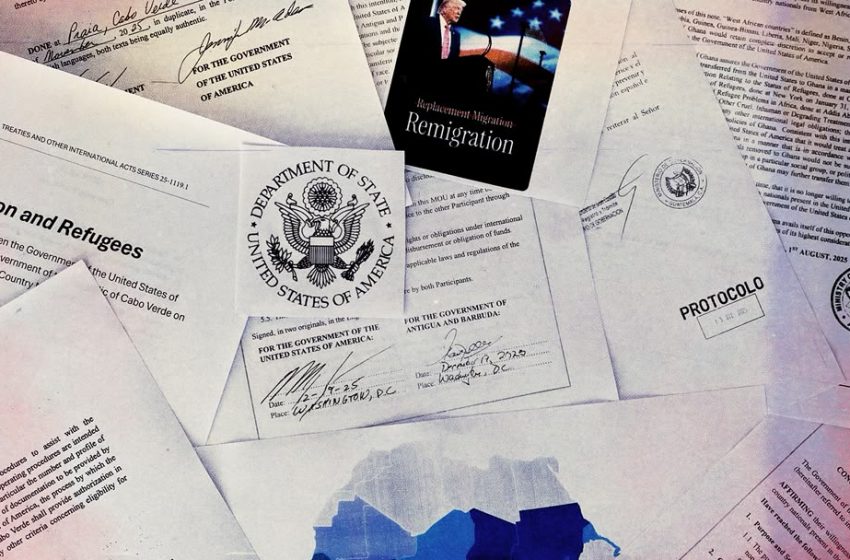
$5.1 million, 160 people — and a deal that began behind closed doors
This investigation is part of The Deportation Project — Inside the Trump administration’s secret deals to expel people worldwide, a collaborative investigation led by Forbiden Stories involving 24 media organisations in 15 countries.
By Inhlase reporter
The men sent to Eswatini did not arrive by accident.
Their transfer was the product of an agreement negotiated between the governments of the United States and Eswatini in the first months of Donald Trump’s second administration.
At the centre of the arrangement was a five-page document signed in Mbabane on 14 May 2025.
It was called a Memorandum of Understanding Between the Government of the United States of America and the Government of Eswatini Concerning the Removal of Third Country Nationals.
Under its terms, the United States agreed to provide Eswatini with US$5.1 million to build its border and migration-management capacity.
In return, Eswatini agreed to facilitate the removal of up to 160 third-country nationals from the United States.
The people could arrive in separate groups. The agreement did not require all 160 to be transferred at once.
The arrangement became one of dozens of third-country deportation agreements pursued by the Trump administration.
The consortium’s database, compiled and cross-checked using the Berkeley Human Rights Center, Human Rights First, Refugees International, news reports, government sources and lawyers handling individual cases, recorded at least 25,427 third-country nationals transferred from the United States between January 2025 and August 31, 2026.
Eswatini accounted for 32 of those people in the consortium’s final database.
But the numbers conceal the more important question:
A deal some ministries did not know about
By the time the money arrived, one of the government’s most important financial institutions says it had not been involved in negotiating the arrangement.
Finance Minister Neal Rijkenberg confirmed in Parliament in November 2025 that Eswatini had received the US$5.1 million.
He said his ministry only discovered the purpose of the payment after making enquiries.
The Eswatini Observer reported the minister as saying: “We were told it was for the US deportees after we enquired”.
Reuters separately reported that Rijkenberg said the transaction had been handled by the Prime Minister and that he was unaware of it until afterwards.
The revelation raised an unusual question about the structure of the deal.
The agreement was between two governments.
The United States was providing millions of dollars.
Eswatini was undertaking an international commitment involving immigration, security and the reception of up to 160 foreign nationals.
What the agreement actually says
The written agreement is more specific than the released public statements initially suggested.
The United States undertook three principal commitments.
First, it would work with Eswatini to identify third-country nationals(TCNs) who were in the United States and could be removed to Eswatini.
Second, it would provide US$5.1 million to build Eswatini’s border and migration-management capacity. The document says that this could include relocation assistance and infrastructure needed to administer assistance for TCNs removed from the United States.
Third, the United States would engage the International Organization for Migration or another service provider, where necessary, to assist with further relocation of TCNs within one year of their arrival in Eswatini.
Eswatini, meanwhile, undertook to act according to its national laws and international obligations.
The agreement specifically refers to the 1951 Refugee Convention, the 1967 Protocol and the Convention Against Torture, including prevention of refoulement and access to asylum and protection systems.
It also agreed to apply its immigration procedures to the transfers and to provide each TCN with “appropriate immigration status or other legal accommodation” under Eswatini law for up to one year.
Washington chose the people
The MOU also makes it clear who controlled the selection process.
Under Annex A, U.S. officials determine independently and under their own authority which third-country nationals they want to remove to Eswatini.
The United States then provides Eswatini’s designated liaison with a list of people, demographic information, criminal records where applicable and an estimated removal schedule.
The Eswatini liaison confirms that the identified group may be removed to Eswatini.
The U.S. liaison then coordinates the flight, with the agreement setting a target of carrying out the transfer within 96 hours of Eswatini’s confirmation.
That arrangement puts the two governments in distinct roles.
Washington chose whom it wanted to remove.
Mbabane agreed to receive the groups.
The agreement does not provide for Eswatini to independently select individual deportees.
That matters when considering the subsequent cases of people with humanitarian protections in the United States.
It also raises a question that neither the agreement nor public statements fully answer:
Up to 160 — but how was the number chosen?
The agreement sets the ceiling at 160 people.
It does not explain in the text why 160 was selected.
Nor does it specify a price per person.
The $5.1 million is described as funding for border and migration-management capacity rather than as a per-person payment.
The document establishes a relationship between the United States providing funding and Eswatini accepting up to 160 TCNs, but it does not say that Washington would pay Eswatini a fixed amount for every person transferred.
The consortium’s global research shows why this distinction matters.
By 31 August 2026, the collaborative investigation had identified 35 countries with agreements or arrangements to accept third-country nationals, of which 28 were known to have actually received people.
The consortium identified more than 105 transfer flights and more than 25,427 people transferred worldwide.
The money attached to the wider system was much larger than the Eswatini payment, although it came through several different channels and should not be treated as a single pool of payments for deportees.
The consortium reporting identified $410.1 million sent through the State Department’s Bureau of Population, Refugees and Migration to governments and international organisations.
That included payments to governments, IOM, UNHCR, the ICRC and the Pan American Development Foundation.
Eswatini’s $5.1 million therefore sits within a much broader financial system — but its precise purpose and spending remain an Eswatini-specific accountability question.
Where did the $5.1 million go?
The money did not initially move through the ordinary government budget in the way many public funds do.
According to reporting by the Eswatini Observer on a Finance Committee report tabled in the House of Assembly in March 2026, the $5.1 million — estimated at about E89 million at the time — had been deposited into a private account rather than the Government Consolidated Fund.
The committee said only about E82 million remained in the account, leaving a reported E7 million shortfall, and recommended that the funds be transferred to the Consolidated Fund and managed like other government money.
The reporting requires further primary-document verification before we describe the E7 million as missing or misappropriated.
What is established by the reporting is that Parliament’s Finance Committee raised concerns about the location and accounting treatment of the money.
The agreement was broader than the money
The $5.1 million is the most visible part of the bargain.
But the MOU itself describes other commitments.
The United States was to engage IOM or another service provider for onward relocation.
Eswatini was to facilitate access for that organisation.
And both governments reaffirmed their existing international obligations.
That means the real bargain was not simply: $5.1 million for 160 people.
It was a system.
Washington would identify the people.
Eswatini would confirm that groups could be received.
The United States would organise the flights.
Eswatini would provide legal accommodation.
An international organisation could become involved in onward relocation.
And, at least on paper, the process was supposed to operate within national and international law.
The question is whether that system worked as the document described.
What was not in the document?
The MOU is striking for what it does not say.
It does not specify that the people will be held in Matsapha Correctional Centre.
It does not establish a criminal sentence.
It does not explain the legal mechanism by which a person who has arrived under the agreement may be prevented from leaving the facility.
It does not identify a maximum period of detention.
It does not specify who has final authority to order an individual’s release.
It does not explain what happens if the person refuses voluntary repatriation.
And although it anticipates further relocation within one year, it does not set out a detailed mechanism for what happens if onward relocation has not occurred when that period expires.
These omissions do not necessarily mean that other legal instruments or administrative arrangements do not exist.
They mean that those instruments need to be identified.
That is one of the central reporting questions for Part Three.
The agreement could also be ended
There is another provision with consequences for people already in Eswatini.
Either participant can discontinue its participation in the MOU at any time, although it should endeavour to provide written diplomatic notice through diplomatic channels.
The document says discontinuation does not require acceptance by the other participant.
What happens when the arrangement ends?
The agreement gives either government the right to discontinue its participation without requiring the other government’s acceptance. But ending the arrangement does not, on the face of the document, provide a separate procedure for people who have already been transferred to Eswatini.
The US–Eswatini MOU, signed on 14 May 2025, says Eswatini will provide each third-country national with “appropriate immigration status or other legal accommodation under Eswatini law” for up to one year. It also says the United States will engage the International Organization for Migration, or another service provider, to assist with further relocation within one year of arrival.
The agreement therefore establishes a transitional arrangement: Eswatini provides the person’s legal accommodation under its law, while the United States undertakes to engage a service provider to assist with onward relocation.
But the MOU does not set out a specific procedure for a person who remains in Eswatini after that one-year period without an onward destination. Nor does its termination clause specify what happens to people already transferred when either government ends its participation.
Instead, the agreement leaves Eswatini’s domestic immigration procedures in place. Section 2.3 of the MOU says Eswatini will “implement its immigration procedures in accordance with Eswatini law,” while section 2.4 provides for legal accommodation for up to one year.
That makes the person’s status under ordinary Eswatini immigration law important once the MOU’s transitional arrangements no longer provide a route to onward relocation.
The government has said the people received under the arrangement are being hosted temporarily while arrangements are made for their onward movement. On 27 August 2026, Acting Government Spokesperson Thabile Mdluli said two additional third-country nationals had been received under the bilateral arrangement according to established procedures governing their “admission and temporary hosting.” On 9 July 2026, she similarly described the July arrivals as being in Eswatini temporarily and said their fundamental rights would be respected and protected during their stay.
The government has also reported individual departures. Some third-country nationals have been repatriated to their countries of nationality, while others have requested voluntary repatriation and the government has said it was engaging relevant authorities and partners to facilitate their departure.
What remains unclear from the public record is what legal status applies to a person in Eswatini when the one-year accommodation period expires and no onward destination has been secured.
That is not a question answered by the MOU itself. It is a question of the domestic legal framework governing the person’s continued presence and movement in Eswatini.
Why did Eswatini say yes?
Eswatini’s government initially presented the arrangement as the product of a lengthy diplomatic process.
On 16 July 2025, after the first five third-country nationals arrived, Acting Government Spokesperson Thabile Mdluli, in a government statement issued to the media, said their arrival was “the result of months of robust high-level engagements” between the United States and Eswatini. She said the government had undertaken risk assessments and that the five men posed no threat to the country or its citizens. The government also said Eswatini and the United States would work with the International Organization for Migration to facilitate the men’s eventual transit to their countries of origin.
Mdluli’s statement also placed the arrangement within the broader relationship between the two countries. She said Eswatini and the United States had enjoyed “fruitful bilateral relations spanning over five decades.”
The following week, the issue reached Parliament. On 21 July 2025, during the House of Assembly Portfolio Committee’s consideration of the Prime Minister’s Office First Quarter Performance Report, MPs questioned the bilateral agreement, including Eswatini’s obligations, national-security implications and the potential benefits to the country.
The government’s explanation was also that the arrangement was intended to be temporary. In her 16 July statement, Mdluli said the men would ultimately be repatriated to their respective countries, with Eswatini and the United States working with IOM to facilitate their onward movement.
That explanation would become more complicated as the programme expanded.
When another 11 third-country nationals arrived in July 2026, Mdluli again spoke on behalf of the government. In a statement reported on 9 July 2026, she described their presence as temporary and said their fundamental rights would be respected and protected in accordance with Eswatini law and the country’s international obligations.
By then, the arrangement was no longer limited to the five men who had arrived a year earlier. It had developed into a continuing programme involving multiple groups of people transferred from the United States.
Reuters reported that Eswatini was among the first countries to volunteer after learning Washington was seeking African partners. The report cited three senior government sources who said the Prime Minister took the proposal to the King.
The High Court eventually dismissed the case Eswatini Litigation Centre and Others v Prime Minister of Eswatini N.O. and Others [2026] SZHC 10 in February 2026 on standing grounds.
It did not rule that the agreement was constitutional.
It did not rule that the detention was lawful.
And it did not determine the substantive constitutional questions surrounding the agreement.
That distinction is important.
The legal challenge therefore did not resolve the political and accountability questions surrounding how the agreement was made.
A bargain still being implemented
By the end of August 2026, the arrangement was no longer merely a document.
The United States had transferred people to Eswatini in multiple operations.
The consortium’s database records 32 people transferred to Eswatini by 31 August.
Some had subsequently left.
Others remained.
On 27 August 2026, Acting Government Spokesperson Thabile Mdluli announced that two further third-country nationals had arrived in Eswatini under the bilateral arrangement with the United States. The government said the two were “of Latin American nationality” and had been received according to established procedures governing the “admission and temporary hosting” of third-country nationals.
Their arrival brought the cumulative number of people transferred to Eswatini under the arrangement to 32 by 31 August, according to the consortium’s verified database. The figure should not be confused with the number of people still in the country: the government said on 27 August that 27 TCNs were then being hosted, following recent repatriations.
The government’s statement did not identify the two people’s individual nationalities. It described them only as “Latin American”.
The government continued to describe the people as temporarily hosted.
The MOU described legal accommodation and eventual further relocation.
But the men described in Part One experienced the arrangement through the walls of Matsapha.
The difference between “temporary hosting” and being held inside a correctional facility is more than a question of language. It goes to the legal status of the men, who controls their movement, and what happens when there is no immediate country to which they can go.
Part Three follows that unresolved legal trail — from the MOU and Eswatini law to the courts, the international organisations involved and the men still waiting for a way out.