
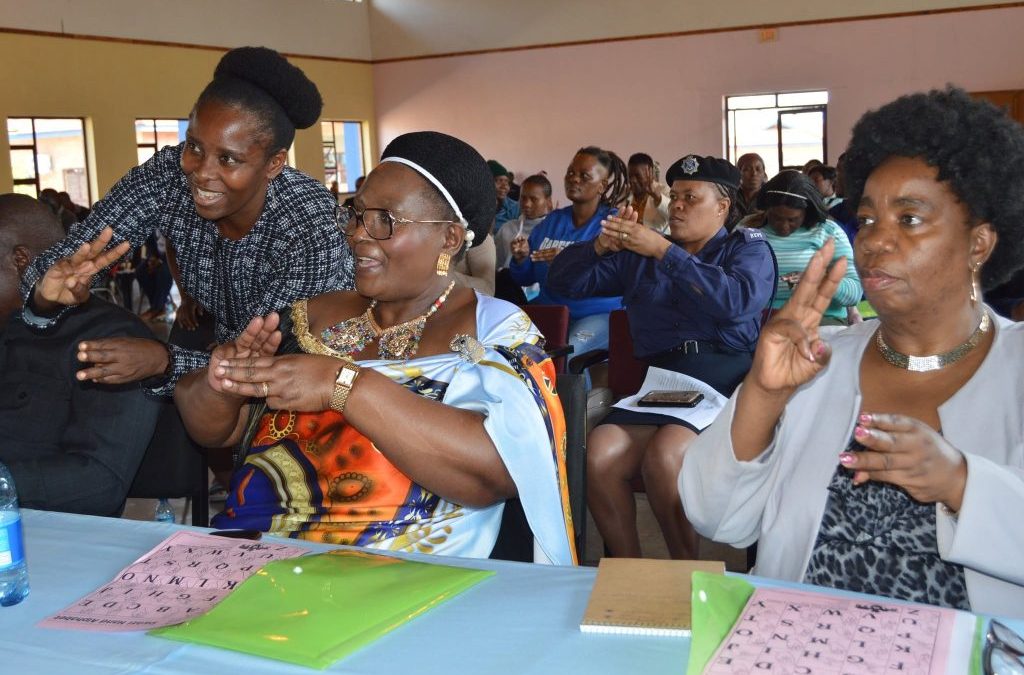
For deaf patients in Eswatini, the struggle to communicate can begin at the hospital door — and follow them through diagnosis, consent, treatment and recovery.
All photos: Deputy Prime Minister’s Office facebook
By Nokukhanya Musi
WHAT TO KNOW
|
Alone and terrified, 42-year-old Sibongile* was in labour with her second child when she arrived at the Raleigh Fitkin Memorial (RFM) Hospital, a mission hospital in Manzini.
Born deaf and communicating mainly through Eswatini Sign Language — a distinct language used by the country’s deaf community, separate from both siSwati and English — she waited an hour before she was attended to and was still unable to understand the spoken instructions swirling around her.
Another patient who knew sign language realised what was happening and offered to interpret for the nurses.
Sibongile’s ordeal didn’t end there.
What followed for Sibongile was a series of life-threatening misunderstandings that reveal a systemic crisis in Eswatini’s healthcare system – the near-total absence of communication support for deaf patients.
Sibongile delivered prematurely, and her baby was diagnosed with jaundice. Unable to understand the doctors’ spoken instructions, she believed she had been discharged, packed her belongings and went home.
“Later that night, my baby developed breathing complications. My aunt had to rush me back to the hospital, where the doctor apologised for the communication barrier,” she recalls.
This is not an isolated incident.
According to the 2017 Population and Housing Census Volume 6, Eswatini has about 22,054 people with hearing difficulty, of whom about 58 per cent are females while males account for 42 per cent.
The census also recorded 146,554 people with difficulties or limitations in performing certain functions, representing 13.4 per cent of the country’s population.
The figures cover a range of difficulties, including hearing, seeing, walking, cognition, self-care and communication.

For deaf people, however, disability can become a barrier to healthcare in a particularly immediate way: when the patient and healthcare provider cannot communicate, even routine medical care can become dangerous.
An Inhlase investigation has uncovered a pattern of communication barriers facing deaf patients across Eswatini’s public healthcare system, resulting in medication errors, misunderstood medical instructions, compromised patient dignity, and potentially life-threatening consequences.
“We do not have any sign language interpreters in our facilities.” — Ministry of Health
A Pattern of Systemic Failure
Interviews with five deaf patients at public healthcare facilities, conducted over a two-week period, alongside interviews with legal and disability experts, revealed persistent communication barriers that leave deaf patients without adequate means to understand and communicate with healthcare providers.
Deaf patients interviewed reported encountering problems at the country’s healthcare facilities, where healthcare workers proficient in sign language are rarely available. As a result, nurses often resort to written notes, which some patients said they have difficulty reading and understanding.
Deaf patients are often forced to rely on relatives or strangers for basic communication, which strips them of privacy and independence.
Repeated concerns raised with the authorities, including the Deputy Prime Minister’s Office and its Disability Unit, they said, have brought no meaningful improvement.
The nurses’ perspective points to the same systemic gap.
Saneliso Mavuso, General Secretary of the Swaziland Democratic Nurses Union (SWADNU), says assisting deaf patients remains a difficult encounter for nurses, who are often left to improvise without the tools or training needed to communicate effectively.
“Nurses find themselves trying gestures themselves, but they aren’t sure if the client comprehends. One is lucky enough if the client is accompanied by a relative who understands and can translate for the nurse,” Mavuso says.
He says nurses and other healthcare personnel are not provided with sign language training by their employers, nor are professional interpreters made available to assist them.
“Nurses are left on their own to figure out how that client gets assisted,” he says.
Mavuso says that while SWADNU has not received a formal complaint from a deaf patient thus far, the communication barrier itself is a serious concern.
“The fact that we can’t converse to comprehend the client thoroughly is enough complaint on its own,” he says.
The consequences, he says, extend across the entire process of care — from assessment and diagnosis to planning, implementation and evaluation.


“The whole management of the clients gets compromised,” Mavuso says.
He believes employers should take responsibility for closing the gap by empowering nurses through sign language workshops, courses and refresher training.
In one case, a deaf woman who preferred to remain anonymous sought treatment at Mbabane Government Hospital after developing a skin rash and flu-like symptoms.
She said she was given medication without instructions she could understand and mistakenly swallowed an ointment intended for external application.
“Blisters later appeared over my whole body and I became very sick. I only discovered this after I returned to the hospital with a sign language interpreter,” she says.
Inhlase could not independently verify the details of her treatment.
The Ministry of Health acknowledges that gaps remain.
Ministry of Health communications officer Nsindiso Tsabedze says Eswatini’s healthcare system operates within the framework of the UN Convention on the Rights of Persons with Disabilities, ratified by Eswatini on 24 September 2012, as well as the Costed National Disability Plan of Action (2026–2028), launched in July 2026.
However, on the question of professional interpretation, the Ministry acknowledges a significant gap.
“We do not have any sign language interpreters in our facilities,” he says.
The Ministry says the disability framework requires persons with disabilities to have equitable and non-discriminatory access to healthcare, with communication and training identified as key targets for implementation.
Under the plan, healthcare providers are expected to receive training in disability sensitivity and sign language to accommodate patients with communication or sensory impairments.
Tsabedze says some health workers previously received basic sign-language training, but many of those trained may no longer be part of the civil service.

The Ministry says it plans to bring back these training courses and is also looking at engaging with the Ministry of Education and Training on how such training can be incorporated into the curriculum of relevant higher education institutions.
The Disability Unit says it has also been engaging the Ministry of Health over accessibility for persons with disabilities.
Fikile Shongwe, the Disability Manager of the Disability Unit within the Deputy Prime Minister’s Office, says the two institutions hold quarterly meetings and that the Unit has issued a memo to service providers calling for disability issues to be mainstreamed and for officers to receive sign language training.
She says the Ministry of Health, like other government ministries, has a disability focal person and is working within the National Disability Plan of Action to remove barriers to healthcare and wellbeing for persons with disabilities, including access to rehabilitation services.
Legal Rights Ignored
Human rights lawyer Sibusiso Nhlabatsi says these experiences are not just medical failures but clear violations of both domestic and international law. The protections extend beyond the Constitution.
Eswatini’s Persons with Disabilities Act, 2018 provides for the rights of persons with disabilities, including access to healthcare without discrimination. The Act also recognises accessible communication as a right, defining communication to include sign language and other accessible modes and formats.
The Act’s provisions on health and accessibility require public services to be accessible to persons with disabilities, while its communication provisions recognise the use of appropriate means of communication, including sign language.
For deaf patients, that obligation has direct implications for communication in healthcare settings, including the provision of appropriate communication support where necessary.
Asked what rights deaf patients hold, Nhlabatsi says: “More than most people assume, and considerably more than most deaf patients have ever been told. The starting point is Chapter III of the Constitution of the Kingdom of Eswatini Act, 2005, our Bill of Rights. Section 14 declares that the fundamental rights and freedoms it contains are inherent, not granted by the State, and it binds the executive, the legislature, the judiciary and every organ and agency of government to respect and uphold them.
“A government hospital is an organ of government. A nurse on duty at Mbabane Government Hospital or Hlathikhulu is bound by section 14 as surely as a magistrate is.”
He points to multiple constitutional provisions that are being systematically violated:


“Section 18 provides that the dignity of every person is inviolable… Section 20 guarantees equality before the law and prohibits discrimination, and it expressly lists disability among the prohibited grounds. Section 30 specifically addresses persons with disabilities… And section 24 protects the freedom to receive information, which is precisely the right that is being defeated when a doctor speaks and the patient cannot hear,” he says.
According to Nhlabatsi, the legal consequences of these failures are significant.
“A procedure performed without valid consent founds a claim under the actio iniuriarum for the violation of bodily integrity and dignity. Where the failure to communicate is itself negligent, both the practitioner and the institution may be liable,” he says. The actio iniuriarum is the common-law claim for injury to dignity.
The Human Cost: Beyond Clinical Errors
Beyond the clinical risks, the investigation revealed a profound impact on patients’ dignity and emotional wellbeing.
A deaf government cleaner described her experience at Nkhaba Clinic as making her feel “less of a human being.”
“Staff repeatedly called other healthcare workers in an attempt to find someone who could communicate with me, but no one knew sign language. Having qualified interpreters in hospitals would have preserved my dignity and allowed me to understand my treatment independently,” she says.
Makhosini Makhubu, President of the National Association of the Deaf of Eswatini (NADE), says these experiences represent “very severe discrimination because the deaf community is not treated as equal with other normal people in general.”
“We have raised this matter with Parliament and have even offered to work with the Ministry of Health in many areas of training and services provision,” Makhubu says.
“Having qualified interpreters in hospitals would have preserved my dignity and allowed me to understand my treatment independently.” — A deaf patient, Nkhaba Clinic
The issue has also been raised in Parliament.
On 29 June 2026, Deputy Prime Minister Senator Thulisile Dladla called for the urgent deployment of sign language interpreters across public clinics and government service centres.
She said every clinic should have access to sign language interpreters and urged the Ministry of Public Service to identify institutions with the greatest need and appoint permanent personnel.
However, the Ministry of Health says there are currently no sign language interpreters in its health facilities.
The gap is also addressed in Eswatini’s disability policy framework.
The Costed National Disability Plan of Action (2026–2028) provides a roadmap for addressing barriers faced by persons with disabilities, including gaps in access to healthcare and communication support.
The framework forms part of broader efforts to strengthen disability inclusion across public services, including improving the capacity of frontline workers to respond to the needs of persons with disabilities while protecting their dignity and confidentiality.
Yet the experiences documented in this investigation suggest that, for deaf patients seeking care, the gap between policy commitments and what happens inside healthcare facilities remains significant.
A System Without Feedback
Also concerning is the evidence that deaf patients have repeatedly reported these issues without seeing meaningful change.
“I reported the communication problems to the Deputy Prime Minister’s Office,” said Sibongile. “No one contacted me afterwards and no changes were made.”
Her account raises a broader question about administrative accountability.
Section 33 of the Constitution provides a right to administrative action that is lawful, reasonable and procedurally fair, as well as the right to written reasons for administrative action where a person’s rights or interests have been adversely affected.
In Sibongile’s case, the unanswered complaint raises questions about whether there was any formal response, investigation or remedial action following her report.
This pattern of complaints without response represents a breach of administrative justice, according to Nhlabatsi.
“Section 33 of the Constitution guarantees the right to administrative justice, including the right to be heard and to be given reasons – which is directly engaged by [Inhlase’s] finding that complaints were lodged and nothing came of them.”
International Standards Ignored
Eswatini ratified the UN Convention on the Rights of Persons with Disabilities (CRPD) on 24 September 2012, committing the country to uphold the rights and protections set out in the treaty.
Article 9 requires accessibility, including measures to facilitate access to information and communications, while Article 25 requires health services to be provided on the basis of free and informed consent.
“Eswatini is not meeting international best practice on this specific question,” Nhlabatsi says.
“We have no legal recognition of Eswatini Sign Language, no accreditation body for interpreters, no national register of qualified medical interpreters, no communication access standard binding on health facilities.”
Practical Solutions Available
“This is not a resource problem of the kind that defeats small states. It is a decision that has not yet been taken.” — Sibusiso Nhlabatsi, human rights lawyer
The solution to this crisis need not be prohibitively expensive or complex, according to experts interviewed.
Video remote interpreting technology has already been developed and deployed in South Africa, allowing deaf people to connect with qualified sign-language interpreters remotely.
Virecom, a South African provider, describes its service as a real-time video interpreting system that can be used in medical emergencies and rural communities.
“A single national on-call interpreting service, reachable from a tablet or a phone in any consulting room, would put competent interpretation within reach of every facility from Lavumisa to Piggs Peak at a fraction of the cost of the alternative,” Nhlabatsi says.
South African sign-language provider Dante Languages publicly advertises interpreting services from R300 an hour, although the published rate does not specifically identify it as a medical video remote interpreting tariff.
“This is not a resource problem of the kind that defeats small states. It is a decision that has not yet been taken,” he says.
The Disability Unit says it is advocating for all service providers to receive sign language training as part of the National Disability Plan of Action, alongside broader disability mainstreaming and inclusive budgeting across government.
Shongwe says the Unit is also pushing for Eswatini Sign Language to be made an official third language, a move she says would form part of efforts to improve communication access for persons with disabilities.
A Call for Action
The Ministry of Health acknowledges that there are currently no sign language interpreters employed in its healthcare facilities — meaning deaf patients seeking care across the public health system have no dedicated professional interpreter available to them.
The admission underscores the scale of the gap documented by this investigation: patients who cannot communicate effectively with healthcare workers are often left to rely on gestures, written communication or relatives and other people to interpret sensitive medical information.
Tsabedze says healthcare workers instead rely on other forms of non-verbal communication, particularly written communication, to assist patients with speech or hearing difficulties.
While acknowledging that this approach “may not always be totally efficient,” he says it helps healthcare workers provide medical assistance.
Patients are also permitted to bring a trusted person to assist with interpretation where one is available.
But this places the burden of overcoming a systemic communication gap on the patient, while potentially compromising privacy, informed consent and the accuracy of medical communication — the very risks that accessible, independent interpretation is intended to prevent.
The Ministry says pharmacy technicians provide written medication instructions to all patients, while patients with visual impairments may require assistance from someone they live with to administer or take medication.
As this investigation went to press, RFM had not responded to requests for comment, despite multiple attempts made between August 10 and August 22 through a questionnaire delivered to the chief executive officer’s personal assistant, phone calls, WhatsApp calls and WhatsApp messages.
The deaf community and legal experts interviewed for this investigation have identified clear recommendations for immediate action:
- Establish a national on-call sign language interpreting service accessible remotely from every healthcare facility.
- Issue a binding communication access standard for all health facilities.
- Amend consent procedures to document how communication was provided to deaf patients.
- Prohibit the use of relatives as interpreters, except in genuine emergencies.
- Build basic sign language and deaf awareness into medical training curricula.
- Secure legal recognition of Eswatini Sign Language.
For patients like Sibongile, these changes cannot come soon enough.
“Deaf patients continue to suffer because healthcare workers do not know sign language. Some deaf patients may lose their lives because they misunderstand medical instructions or medication due to communication barriers,” she says.
Nhlabatsi says the failure is systemic: it cannot be explained by individual attitudes, because individual attitudes are never uniform.
“It can only be explained by a common cause upstream of all of them – that the system has no provision for this and therefore produces the same failure wherever it is tested,” he says.
Until those systemic changes are implemented, deaf patients in Eswatini will continue to face the dangerous silence of a healthcare system that cannot hear them.
*Name has been changed to protect her privacy.
| ABOUT THIS INVESTIGATION Inhlase interviewed five deaf patients treated at public healthcare facilities over a two-week period, alongside nurses’ representatives, disability advocates and legal experts. One patient is identified by a pseudonym, marked with an asterisk; a second source spoke on condition of anonymity. The Ministry of Health and the Deputy Prime Minister’s Office responded to Inhlase’s questions. Raleigh Fitkin Memorial Hospital did not respond to requests for comment made between 10 and 22 August through a questionnaire delivered to the CEO’s personal assistant, phone calls, WhatsApp calls and WhatsApp messages. Disability figures are drawn from the 2017 Population and Housing Census (Volume 6). This story was edited with the support of AI tools under the supervision of the Inhlase editorial desk. |